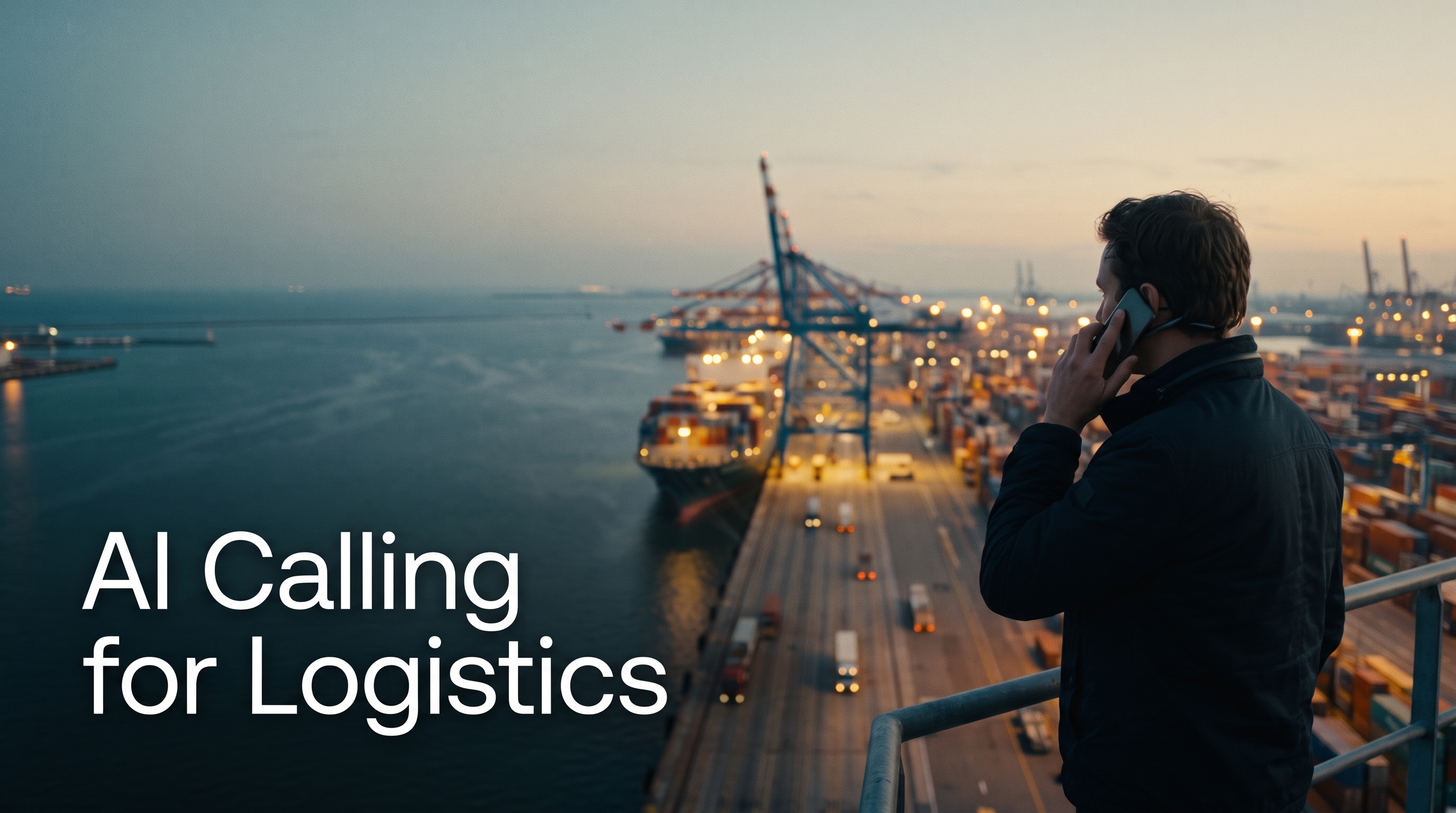
Logistics and e-commerce businesses often struggle with a critical problem: failed deliveries. These aren't just minor inconveniences; they lead to significant financial losses, unhappy customers, and operational headaches. Imagine a delivery agent waiting at a customer's door, only to find no one home, or a package returned to the warehouse because of an incorrect address. Each such instance stacks up costs in reverse logistics, fuel, and wasted time. In India, first-attempt delivery failure rates in urban markets can be as high as 20% to 30%, with each failed delivery costing ₹180–₹400.
This is where AI calling for logistics, specifically for Non-Delivery Report (NDR) calls, comes in. This article will explain how AI voice agents can address these challenges, improve delivery success rates, and enhance customer satisfaction, all while keeping costs in check. We will also cover the benefits, practical applications, and key features to consider when adopting such a solution.
Get started with 1 hour of free credits at tabbly.io.
What is AI Calling for Logistics?
AI calling for logistics involves using intelligent voice agents to automate communication tasks within the supply chain. For NDR calls, this means an AI voice agent automatically contacts customers after a failed delivery attempt to understand the reason and facilitate a redelivery or alternative action. This is more than just a pre-recorded message; it's a dynamic, conversational interaction.
For example, if a delivery fails, an AI voice agent might call the customer and say: "Hi! This is QuickShip calling regarding your recent delivery. We attempted to deliver your package today, but it was unsuccessful. Could you please tell us why you weren't able to receive it?" The AI can then understand the customer's response – whether it's an incorrect address, unavailability, or a request to reschedule – and take appropriate action, like rescheduling the delivery or updating the address in the system.
Get started with 1 hour of free credits at tabbly.io.
Want to see this in action? Book a 30-minute demo.
Why AI Calling Matters Now for Logistics
The logistics sector is under immense pressure. Customer expectations for fast and predictable deliveries are higher than ever, fueled by quick commerce. Yet, operational challenges like traffic congestion, address ambiguity, and high delivery costs persist, especially in India.
Manual NDR follow-ups are slow and resource-intensive. Human agents can only make so many calls, leading to delays and further failed attempts. This directly impacts the bottom line; every failed delivery is a direct cost, with zero revenue in return. AI calling offers a scalable, efficient, and cost-effective way to tackle these issues head-on, ensuring that every failed delivery is addressed promptly and effectively, even during after-hours.
Get started with 1 hour of free credits at tabbly.io.
How AI Calling Fixes Failed Deliveries and Its Benefits
AI voice agents can significantly reduce failed deliveries and their associated costs by automating the NDR resolution process. Here’s how it works and the benefits it brings:
Steps for AI-Powered NDR Resolution
- Automated Trigger: When a delivery attempt fails, the logistics system automatically triggers an AI voice agent to call the customer.
- Intelligent Conversation: The AI agent initiates a natural conversation, explaining the failed delivery and asking for the reason. It can understand various responses, such as "I was not home," "The address is wrong," or "Please deliver tomorrow."
- Real-time Action: Based on the customer's input, the AI can perform actions like rescheduling the delivery for a new time slot, updating the delivery address in the CRM/TMS, or confirming a cash-on-delivery (COD) order before re-dispatch.
- System Integration: The AI seamlessly integrates with existing logistics systems (CRM, TMS, WMS) to update information and trigger further actions, like sending an SMS confirmation of the rescheduled delivery.
- Human Handoff (Optional): For complex issues that the AI cannot resolve, it can intelligently transfer the call to a human agent with all the conversation context, ensuring a smooth escalation.
Key Benefits of AI Calling for Logistics
- Reduced RTO (Return to Origin) Rates: By proactively resolving NDRs, businesses can significantly lower the number of packages that are returned to the origin, which directly impacts profitability. Some companies have seen a 30% lower RTO rate through NDR automation.
- Improved Delivery Success Rates: Pre-delivery confirmation calls and quick NDR resolution lead to fewer missed deliveries, with some seeing a 50% reduction.
- Lower Operational Costs: Automating repetitive NDR calls frees up human agents to focus on more complex tasks, reducing labor costs and increasing efficiency.
- 24/7 Customer Coverage: AI voice agents can operate around the clock, ensuring that NDRs are addressed promptly, even outside business hours, which is crucial for time-sensitive deliveries.
- Enhanced Customer Satisfaction: Proactive communication and efficient resolution of delivery issues lead to a better customer experience, fostering loyalty.
- Multilingual Support: With support for 50+ languages, including Hindi, Hinglish, Tamil, Telugu, Kannada, Marathi, and Gujarati, AI agents can communicate with a diverse customer base across India.
- Better Data and Analytics: Every AI-powered call provides valuable data on reasons for failed deliveries, customer preferences, and agent performance, enabling continuous improvement.
Get started with 1 hour of free credits at tabbly.io.
Want to see this in action? Book a 30-minute demo.
Use Cases and Industries for AI Calling in Logistics
AI calling extends beyond just NDR resolution, offering broad applications across the logistics and transportation industry.
Common Logistics Use Cases
- Delivery Confirmation & Rescheduling: Proactive calls to confirm customer availability before delivery and reschedule if needed.
- COD Pre-Confirmation: Verifying Cash on Delivery orders before dispatch to reduce refusal rates at the doorstep.
- Address Verification: Calling customers to confirm or correct incomplete or ambiguous addresses, a common challenge in India.
- Shipment Status Updates: Providing real-time tracking information and estimated times of arrival (ETAs) to customers, reducing inbound calls to support teams.
- Driver Coordination: Automating routine check-ins, pickup confirmations, and route updates with delivery personnel.
- Return Pickup Scheduling: Arranging reverse pickups with customers via an automated call.
- Post-Delivery Feedback: Collecting Net Promoter Score (NPS) or other feedback after successful deliveries.
Industries That Benefit
- E-commerce & Retail: Essential for managing high volumes of last-mile deliveries and reducing RTOs.
- Food & Grocery Delivery: Critical for time-sensitive deliveries and ensuring customer availability.
- Pharmaceutical Logistics: Confirming delivery of medicines and sensitive goods.
- Courier & Express Services: Streamlining package delivery and exception handling.
- Third-Party Logistics (3PLs): Enhancing operational efficiency for diverse client portfolios.
Get started with 1 hour of free credits at tabbly.io.
How to Choose an AI Calling Platform for Logistics
When evaluating AI calling solutions for your logistics operations, consider these practical features:
- Conversational AI Capabilities: Look for a platform that offers natural language understanding (NLU) and generation (NLG) to handle complex customer queries and maintain a human-like flow. The AI should be able to understand intent, extract relevant information, and respond contextually.
- Multilingual Support: For a diverse market like India, support for multiple regional languages and dialects, including Hinglish, is non-negotiable.
- Integration with Existing Systems: The platform must seamlessly integrate with your CRM, TMS, WMS, and other operational systems to access real-time data and update records. APIs are crucial for this.
- Scalability and Concurrency: Ensure the solution can handle high call volumes and unlimited concurrent calls without performance degradation, especially during peak seasons.
- Compliance Features: For operations in India, adherence to TRAI's DLT framework is critical. This includes DLT registration, DND scrubbing, and using the correct number series (140 for promotional, 1600/1601 for service/transactional calls). The platform should support real-time DND scrubbing and allow for the declaration of A2P (Application-to-Person) calls.
- Pricing Model: Look for transparent, usage-based pricing that aligns with your call volumes. Pay-as-you-go options can be beneficial for fluctuating needs.
- No-Code Builder & APIs: A no-code interface allows your operations team to build and modify call flows easily, while APIs provide flexibility for developers to create custom integrations.
- Analytics and Reporting: Comprehensive dashboards with call recordings, transcripts, and performance metrics are essential for monitoring and optimizing your AI agents.
- Data Residency Options: For businesses operating in India, having local data residency options can be important for compliance and data sovereignty.
Get started with 1 hour of free credits at tabbly.io.
Want to see this in action? Book a 30-minute demo.
Why Businesses Pick Tabbly for AI Calling in Logistics
Businesses choose Tabbly for their AI calling needs in logistics because it directly addresses the practical challenges they face. Tabbly's platform is built for real-world operations, offering a balanced approach to advanced AI capabilities and ease of use.
Our voice agents support over 50 languages, including Hindi, Hinglish, Tamil, Telugu, Kannada, Marathi, and Gujarati, ensuring effective communication across India's diverse linguistic landscape. This is crucial for connecting with every customer, regardless of their preferred language. The no-code builder allows operations teams to quickly set up and modify NDR call flows, while robust APIs provide developers the flexibility for deep integrations with existing logistics software. This means faster deployment and less reliance on external technical teams.
Tabbly offers transparent, usage-based pricing: ₹6.80 per minute on a pay-as-you-go model in India, with rates dropping to ₹5.10 per minute for committed volumes from 5,000 minutes per month. In USD, this is $0.05 per minute PAYG, and $0.04 per minute for large committed volumes. All calls are billed to the second, ensuring you only pay for what you use. This predictable cost structure helps logistics companies manage budgets effectively, especially when dealing with fluctuating call volumes. We also provide numbers in over 50 countries, including +91, with India and US data-residency options. Our platform is designed for unlimited concurrency on published plans, meaning your AI agents can handle any volume of calls simultaneously without queuing. Multilingual AI Calling: Outbound Campaigns in 50+ Languages
Get started with 1 hour of free credits at tabbly.io.
Conclusion
Failed deliveries are a significant drain on resources and customer satisfaction in the logistics industry. Traditional manual approaches to resolving Non-Delivery Reports (NDRs) are no longer sufficient in today's fast-paced, high-volume environment. AI calling for logistics offers a powerful and practical solution, automating NDR calls to improve delivery success rates, reduce costs, and enhance the overall customer experience.
By leveraging AI voice agents, businesses can ensure proactive communication, intelligent rescheduling, and seamless integration with their existing systems. This allows human agents to focus on more complex tasks, while the AI handles the repetitive, high-volume interactions that drive down efficiency. The benefits are clear: lower RTO rates, improved operational efficiency, and happier customers who receive their packages on time. AI Voice Agent Cost: Per-Minute vs. Call Center
Tabbly provides a robust AI calling platform designed specifically for these challenges. With extensive language support, flexible pricing, and critical compliance features for markets like India, Tabbly empowers logistics businesses to transform their delivery operations. It’s about making every call count and ensuring that a failed delivery doesn't become a lost customer.
Get started with 1 hour of free credits at tabbly.io.
Frequently Asked Questions
What is AI Calling for Logistics?
AI calling for logistics uses intelligent voice agents to automate phone interactions across the supply chain. This includes tasks like confirming deliveries, providing shipment updates, coordinating with drivers, and crucially, resolving Non-Delivery Reports (NDRs) by contacting customers after a failed delivery attempt to reschedule or gather information.
Which businesses benefit most from AI Calling for NDRs?
Businesses with high volumes of last-mile deliveries, such as e-commerce companies, quick commerce platforms, food delivery services, and third-party logistics (3PL) providers, benefit significantly. Any business experiencing frequent failed deliveries and associated costs will find value in automating NDR resolution.
Can AI voice agents replace human agents in logistics?
No, AI voice agents do not replace human agents entirely. Instead, they handle the repetitive, high-volume, and routine calls that often overwhelm human teams. This frees up human agents to focus on complex problem-solving, customer relationship building, and critical escalations, making the overall operation more efficient and effective.
Does AI calling support Indian languages and compliance?
Yes, platforms like Tabbly offer extensive support for over 50 languages, including major Indian languages such as Hindi, Hinglish, Tamil, Telugu, Kannada, Marathi, and Gujarati. For compliance in India, AI calling platforms must adhere to TRAI's DLT framework, including DLT registration, real-time DND scrubbing, and using specific number series for commercial calls.
How does AI calling integrate with existing CRM and logistics systems?
AI calling platforms integrate with existing CRM, TMS, WMS, and other logistics systems through APIs. This allows the AI agent to access real-time data for accurate responses (e.g., shipment status) and update records automatically based on customer interactions (e.g., rescheduling a delivery). This ensures data consistency and automates workflows.
Why choose Tabbly for AI Calling in logistics?
Tabbly offers a robust AI calling platform with support for 50+ languages, including major Indian languages, making it ideal for diverse customer bases. It features a no-code builder for easy workflow creation, strong API capabilities for system integration, and transparent, usage-based pricing starting at ₹6.80/minute in India (or $0.05/minute). Tabbly also supports necessary TRAI DLT compliance requirements and provides numbers in over 50 countries, including +91, with India and US data residency options. AI Calling Software India: The Complete Guide to AI Voice Calling Solutions for Businesses (2026)