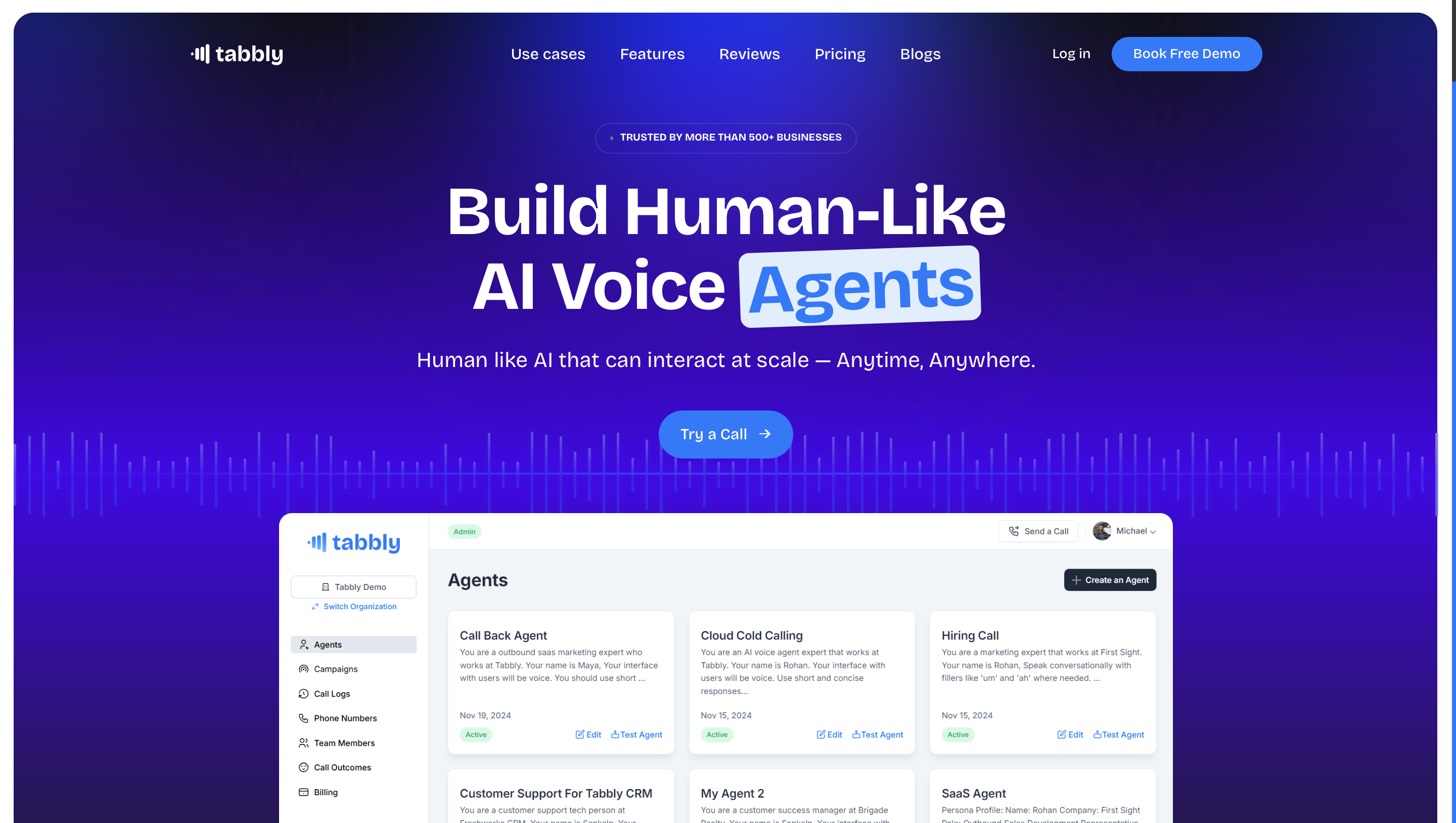
The landscape of customer service is undergoing a dramatic transformation. AI voice agents are no longer a futuristic concept they're actively handling millions of inbound calls across industries, from healthcare to e-commerce. Platforms like Tabbly.io are making it possible for businesses to deploy human-like AI voice agents in minutes, with support for over 50 languages and natural conversational capabilities. But how exactly do these digital assistants differ from their human counterparts? Understanding these differences is crucial for businesses considering AI implementation and customers adapting to this new reality.
Book your demo at: https://cal.com/tabbly/30min
The Fundamental Shift: Processing vs. Understanding
The most striking difference lies in how AI and humans process information during a call. Human agents rely on years of social conditioning, emotional intelligence, and contextual understanding built through lived experience. They can pick up on subtle vocal cues, understand sarcasm, and read between the lines of what a caller is actually asking for.
AI voice agents, by contrast, operate through pattern recognition and natural language processing. They analyze speech patterns, identify keywords, and match queries to their trained responses. Modern AI systems like those built on large language models have become remarkably sophisticated at understanding context and intent, but they approach comprehension fundamentally differently than humans do.
Learn more about TCPA Rules
Speed and Consistency: Where voice AI technology Excels?
Instant Response Time
AI voice agents can process and respond to queries in milliseconds. There's no pause to think, no need to search through documentation, and no "let me transfer you to someone who can help." When a caller asks about their account balance, shipping status, or appointment availability, AI can retrieve and deliver that information almost instantaneously.
Platforms like Tabbly.io have optimized for sub-second response times, maintaining natural conversation flow even while performing complex reasoning tasks. Through intelligent response streaming and predictive processing, these systems can provide conversational acknowledgments like "Let me check that for you..." while working on the solution in the background, eliminating awkward silences.
Human agents, even the most experienced ones, need time to navigate systems, pull up information, and formulate responses. A task that takes an AI agent two seconds might take a human agent 30 seconds or more.
Unwavering Consistency
AI voice agents deliver the same quality of service on the 1st call and the 10,000th call. They don't have bad days, don't get frustrated with difficult customers, and don't provide inconsistent information based on mood or fatigue. Every caller receives the same level of attention and accuracy.
Human agents, while capable of exceptional service, are subject to human variability. Energy levels fluctuate, attention wanes during long shifts, and personal circumstances can affect performance. Two customers with identical issues might receive noticeably different experiences depending on when they call and which agent they reach.
Book your demo at: https://cal.com/tabbly/30min
The Core Shift: From Human-Limited to AI-Powered
Human agents bring empathy and creativity to calls, but they're constrained by biology and logistics. AI voice agents, powered by advanced large language models (LLMs), speech recognition, and real-time processing, operate without those limits.
Here's a quick side-by-side comparison:
| Aspect | Human Agents | AI Voice Agents (e.g., Tabbly) |
| Availability | Business hours only | 24/7, no breaks or holidays |
| Response Time | 30–120 seconds (queue time) | Under 300ms |
| Concurrency | 1 call per agent | Unlimited (handles 1000s simultaneously) |
| Consistency | Varies by mood, experience | Always on-brand, error-free |
| Cost per Minute | $0.50–$1.00+ (including overhead) | As low as $0.03–$0.05 |
| Language Support | Limited to team skills | 50+ languages natively |
These aren't just tweaks—they're fundamental advantages that let AI handle inbound calls in ways humans simply can't match at scale
Availability and Scalability: The 24/7 Advantage
AI voice agents operate continuously without breaks, vacations, or shift changes. A company can handle peak call volumes at 3 AM on a holiday with the same efficiency as a Tuesday afternoon. This availability is particularly valuable for global businesses serving customers across multiple time zones.
Modern AI voice platforms like Tabbly.io support 50+ languages with native accuracy, including major Indian and international languages with cultural nuances and regional dialects. This multilingual capability, combined with the ability to deploy phone numbers in over 50 countries, makes truly global customer service accessible to businesses of all sizes.
Scaling is equally straightforward. Adding capacity for 100 more simultaneous calls doesn't require hiring, training, and onboarding new employees it's simply a matter of infrastructure. Tabbly.io's distributed voice infrastructure can execute massive campaigns with thousands of AI voice calls running simultaneously without performance degradation. During unexpected surge events like product launches, system outages, or viral social media moments, AI can absorb massive call volume spikes that would overwhelm traditional call centers.
Human call centers require careful workforce planning, shift scheduling, and contingency staffing. Scaling up means recruitment, training periods, and ongoing management overhead. Scaling down raises ethical and practical concerns about layoffs and retention.
Emotional Intelligence: The Human Advantage
Here's where the gap between AI and human agents remains most significant. Humans possess genuine empathy the ability to truly understand and share the feelings of another person. When a customer calls upset about a cancelled flight that will make them miss a wedding, a human agent can connect with that emotion on a personal level.
AI can recognize emotional indicators in speech patterns and adjust its tone accordingly. Advanced platforms like Tabbly.io include built-in sentiment analysis that can detect frustration, excitement, or confusion in real-time, allowing the AI to adjust its tone and approach. The system can be programmed to express sympathy and use comforting language. But this is simulation, not genuine emotional resonance. The AI doesn't actually understand what it feels like to be disappointed or stressed.
Complex Emotional Situations
For straightforward transactions, AI's simulated empathy often suffices. But in high-stakes situations healthcare concerns, financial distress, bereavement-related calls human agents provide a level of compassionate understanding that AI cannot replicate. The knowledge that another person genuinely cares about your situation has psychological value that extends beyond the practical resolution of an issue.
Book your demo at: https://cal.com/tabbly/30min
Handling Complexity and Edge Cases by conversational AI
Routine Queries: AI's Sweet Spot
AI voice agents excel at handling predictable, structured interactions. Questions like "What's my account balance?", "When will my order arrive?", or "What are your business hours?" fall well within AI's capabilities. These queries have clear parameters, defined data sources, and straightforward resolution paths.
Novel Situations: Human Adaptability
Humans shine when confronted with unprecedented situations that require creative problem-solving. Consider a customer who needs to modify an order but has lost access to their email, forgotten their password, and is calling from a different phone number. A human agent can navigate this complex scenario by asking clarifying questions, applying judgment about verification alternatives, and potentially bending standard protocols when appropriate.
AI voice agents follow defined decision trees and escalation protocols. When faced with scenarios outside their training, they typically transfer to a human agent rather than attempting improvised solutions. This is by design it's safer for AI to recognize its limitations than to make potentially costly mistakes.
Multitasking and Context Switching by conversational AI
AI voice agents handle each call in isolation with perfect focus. They can instantly switch between different types of queries without cognitive load. One call might be about a billing question, the next about product troubleshooting, followed by an appointment booking the AI approaches each with equal readiness.
Human agents experience cognitive overhead when switching between very different types of calls. Transitioning from a complex technical support issue to a simple account update requires mental adjustment. However, humans excel at managing multiple threads within a single conversation, handling subtle topic shifts, and maintaining coherent context over long, meandering calls.
Book your demo at: https://cal.com/tabbly/30min
Learning and Improvement of AI Voice agents
AI: Pattern-Based Evolution
AI voice agents improve through data accumulation and model refinement. Every call generates data that can be analyzed to identify common patterns, failure points, and opportunities for enhanced responses. Updates to AI systems can be deployed instantly across all agents, ensuring improvements benefit every subsequent caller.
However, AI learns what it's trained to learn. It doesn't develop intuition or spontaneously discover better approaches outside its training parameters.
Humans: Experience-Based Growth
Human agents develop expertise through experience, learning not just from their own calls but from colleagues, training sessions, and even personal life experiences that inform their approach to customer service. They can apply lessons from one situation to entirely different contexts in ways that AI cannot.
Cost Considerations of conversational AI: The Business Perspective
The economics of AI versus human agents represents a significant factor in adoption decisions. AI voice agents have substantial upfront development and implementation costs but minimal ongoing operational expenses. Once deployed, an AI agent handling 10,000 calls costs nearly the same as one handling 100 calls.
Platforms like Tabbly.io have democratized access to AI voice technology with usage-based pricing as low as $0.05 per minute. Businesses only pay for active conversation time, making it cost-effective for organizations of all sizes. A customer service bot handling 1,000 conversations daily with 100-word responses might cost around $225 per month compared to thousands in human agent salaries.
Human agents involve lower initial investment but ongoing costs for salaries, benefits, training, management, and infrastructure. The cost per call remains relatively constant regardless of technology investments.
For businesses, the calculation isn't simply about replacing humans with AI to reduce costs. The optimal approach often involves AI handling high-volume, routine interactions while human agents focus on complex cases, relationship building, and situations requiring genuine emotional intelligence.
Book your demo at: https://cal.com/tabbly/30min
Privacy and Data Handling of AI Voice agents
AI voice agents process information according to strict programming rules. They can be designed to never store sensitive information, to automatically redact personal data, and to apply security protocols perfectly consistently. There's no risk of an AI agent inadvertently discussing customer information inappropriately or being socially engineered into revealing protected data.
Human agents, despite training and policies, introduce human error into data security. They might accidentally pull up the wrong account, mishear information, or in rare cases, deliberately misuse access to customer data.
Conversely, AI systems create new privacy considerations. Voice data used for training or quality improvement must be handled carefully. The centralized nature of AI systems means a security breach could potentially expose vast amounts of call data, whereas human agents represent distributed points of information access.
Book your demo at: https://cal.com/tabbly/30min
The Future: Hybrid Approaches
The emerging consensus isn't that AI will replace human agents entirely, but rather that the most effective customer service operations will leverage both strategically. AI handles the predictable, the repetitive, and the straightforward, freeing human agents to focus on complex problem-solving, emotional support, and relationship building.
Advanced systems are developing seamless handoff protocols where AI handles initial interaction, resolves simple queries, gathers relevant information, and escalates to humans only when necessary already briefing the human agent on the context before they engage.
Making the Right Choice for Your Business
Organizations evaluating AI voice agents should consider several factors:
When AI Makes Sense:
- High volume of routine, predictable inquiries
- Need for 24/7 availability
- Straightforward data retrieval and transaction processing
- Industries where consistency is paramount
- Budget constraints limiting human staffing
When Humans Remain Essential:
- Complex problem-solving requiring judgment
- High-stakes emotional situations
- Brand positioning built on personal service
- Industries with significant regulatory complexity
- Situations where empathy provides tangible value
Book your demo at: https://cal.com/tabbly/30min
The Rise of No-Code AI Voice Platforms
One of the most significant developments in AI voice technology is the emergence of no-code platforms that make this technology accessible to businesses without technical expertise. Tabbly.io exemplifies this trend, allowing companies to build and deploy human-like AI voice agents in under five minutes.
These platforms offer:
Pre-Built Templates: Choose from 50+ use case templates for customer service, sales outreach, appointment scheduling, lead qualification, and more. Businesses can launch production-ready agents the same day they sign up.
Seamless Integrations: Native connectors for CRMs like Salesforce, HubSpot, and Pipedrive, plus integration with automation platforms like Zapier, n8n, and Make.com. This allows AI voice agents to access real-time data and trigger workflows across your existing tech stack.
Real-Time Analytics: Comprehensive analytics including call recordings, AI transcription, sentiment analysis, and detailed interaction metrics help businesses continuously optimize performance.
Agentic Capabilities: Modern platforms are evolving beyond simple question-and-answer to agentic AI that can autonomously plan multi-step actions, make decisions, and complete complex tasks like order management, appointment rescheduling, and payment collection.
For small and medium businesses in particular, these platforms level the playing field. Companies that previously couldn't afford 24/7 call centers can now provide enterprise-grade customer service. Businesses report conversion boosts of 30%, 60-80% first-call resolution for complex inquiries, and up to 60% reduction in support costs.
Book your demo at: https://cal.com/tabbly/30min
Conclusion
AI voice agents and human agents don't handle inbound calls differently just in terms of technology they represent fundamentally different approaches to customer interaction. AI brings speed, consistency, availability, and scalability. Humans offer emotional intelligence, creative problem-solving, genuine empathy, and adaptability to novel situations.
The question isn't which is better, but rather how to deploy each where they provide the most value. As AI continues advancing, the line between artificial and human interaction will blur further, but the fundamental differences in how they process, understand, and respond to human needs will remain relevant for the foreseeable future.
Businesses that understand these differences and strategically implement hybrid approaches will deliver superior customer experiences while optimizing operational efficiency. The future of customer service isn't human or AI it's human and AI, each contributing their unique strengths to serve customers better than either could alone.
Book your demo at: https://cal.com/tabbly/30min
Getting Started with AI Voice Agents
For businesses ready to explore AI voice agents, platforms like Tabbly.io make implementation straightforward:
- Start with a pilot: Deploy AI for a specific, well-defined use case like appointment scheduling or order status inquiries
- Measure and optimize: Use analytics to understand performance and identify improvement opportunities
- Train for natural interactions: Invest time in crafting prompts and personality traits that align with your brand
- Plan the human handoff: Design seamless escalation protocols for when AI reaches its limits
- Scale strategically: Expand to additional use cases based on proven ROI
With usage-based pricing starting at just cents per minute and deployment times measured in minutes rather than months, the barrier to entry has never been lower. Whether you're a startup looking to punch above your weight or an enterprise seeking to handle peak volumes efficiently, AI voice agents offer a practical path to better customer service.
Book your demo at: https://cal.com/tabbly/30min
Frequently Asked Questions
1. What is an AI voice agent? An AI voice agent is an automated system powered by artificial intelligence that can handle phone conversations with customers. It uses natural language processing to understand speech, respond to questions, and complete tasks like appointment scheduling, order tracking, and customer support without human intervention.
2. How are AI voice agents different from traditional IVR systems? Traditional IVR (Interactive Voice Response) systems use rigid menu options ("Press 1 for sales, press 2 for support"), while AI voice agents understand natural conversational language. You can speak normally to an AI voice agent as if talking to a human, and it will comprehend your intent without requiring button presses or specific keyword phrases.
3. Can AI voice agents really sound human? Yes, modern AI voice agents using advanced text-to-speech technology sound remarkably human-like with natural intonation, pauses, and conversational flow. Platforms like Tabbly.io offer ultra-realistic voices in 50+ languages that many callers cannot distinguish from human agents during routine interactions.
4. What types of calls can AI voice agents handle? AI voice agents excel at:
- Appointment scheduling and reminders
- Order status inquiries
- Lead qualification and follow-up
- Customer support for common questions
- Payment collection and processing
- Survey and feedback collection
- Reservation bookings
- Information requests (hours, locations, pricing)
5. When should calls be transferred to human agents? Calls should escalate to humans when:
- The situation requires complex problem-solving or judgment calls
- Customers are highly emotional or distressed
- The issue is unprecedented or outside the AI's training
- Sensitive matters require genuine empathy
- The customer specifically requests a human agent
- Regulatory compliance requires human oversight
6. How much do AI voice agents cost compared to human agents? AI voice agents typically cost $0.05-0.08 per minute of conversation time with platforms like Tabbly.io. A business handling 1,000 daily calls might spend around $225/month versus thousands in human agent salaries. However, initial setup and integration costs vary by platform and complexity.
7. Do AI voice agents work 24/7? Yes, AI voice agents operate continuously without breaks, holidays, or time-off. They can handle calls at 3 AM with the same quality as 3 PM, making them ideal for global businesses serving multiple time zones or providing round-the-clock customer support.
8. How long does it take to set up an AI voice agent? With no-code platforms like Tabbly.io, you can deploy a basic AI voice agent in under 5 minutes using pre-built templates. More customized implementations with CRM integrations and complex workflows might take a few hours to a few days, but this is still dramatically faster than hiring and training human staff.
9. Can AI voice agents speak multiple languages? Yes, modern AI voice platforms support 50+ languages including English, Spanish, French, German, Hindi, Tamil, Telugu, Arabic, Mandarin, and many others. The same AI agent can often switch languages mid-conversation based on the caller's preference.
10. How do AI voice agents handle angry or frustrated customers? AI voice agents use sentiment analysis to detect frustration or anger in a caller's tone and can adjust their approach accordingly—speaking more slowly, using empathetic language, and offering to escalate to a human agent. However, for highly emotional situations, immediate transfer to a human agent is often the best approach.